WWF Hasbro Research
Was Big Boss Man Really Series 3? Decoding WWF Hasbro’s Numbering System
Collectors have organised WWF Hasbro into neat "Series" for decades. Hasbro itself, however, appears to have worked more fluidly with product numbers, assortment numbers and carry-forward figures. Once you look at the line that way, Big Boss Man 2 makes far more sense as a Series 3 figure.
Big Boss Man sits right in the middle of Series 3
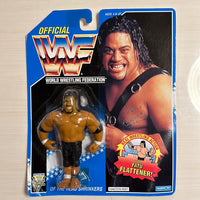
The second Big Boss Man figure carries Hasbro item number 7043, with UPC 038976070437.
That number becomes much more interesting when we place it alongside the figures immediately around it. Big Boss Man does not merely have a number vaguely associated with Series 3. He sits directly between two figures collectors already recognise as Series 3, with more Series 3 figures following shortly after.
| Hasbro Item | Figure | Collector Series |
|---|---|---|
| 7042 | Ultimate Warrior 3 | Series 3 |
| 7043 | Big Boss Man 2 | Series 3 |
| 7044 | Texas Tornado | Series 3 |
| 7047 | Mr Perfect 1 | Series 3 |
| 7048 | Koko B. Ware | Series 3 |
| 7111 | Bret "Hitman" Hart | Series 4 |
| 7112 | British Bulldog | Series 4 |
| 7113 | The Undertaker | Series 4 |
| 7114 | Ricky "The Dragon" Steamboat | Series 4 |
Why has there ever been confusion?
Because a Hasbro assortment and a collector series are not necessarily the same thing.
On many WWF Hasbro packages, Hasbro printed two numbers in a format such as 7037 / 7035 ASST.
In that example, 7037 identifies the Rockers product, while 7035 identifies the assortment in which that particular release was being sold.
Product number = what the toy is.
Assortment number = the group of products Hasbro was shipping it with.
The Bushwhackers make this especially clear. We have found packaging marked both 7039 / 7035 ASST. and later 7039 / 7060 ASST.
The individual product number stayed 7039. What changed was the assortment. In other words, Hasbro could move a product forward into a later assortment without turning it into a new product.
Hasbro carried figures forward all the time
This was not an isolated practice. Several early WWF Hasbro figures can be found under more than one assortment number.
Brutus Beefcake 1 appears as 7003 / 7010 and later 7003 / 7025. Big Boss Man 1 similarly appears as 7005 / 7010 and later 7005 / 7025. Jake "The Snake" Roberts was also carried forward while retaining his individual product identity.
Hulk Hogan is perhaps the clearest example of Hasbro's willingness to keep a popular figure in circulation. Hogan 1 was carried forward from an earlier assortment, and planning evidence indicates that Rowdy Roddy Piper was later pushed out of a planned assortment to make room for another Hulk Hogan 1 carry-forward.
That is important when discussing Big Boss Man 2. A figure appearing in, or being carried into, a later assortment does not automatically mean that figure originated as part of the later collector-defined "Series".
WWF Hasbro "Series" are collector shorthand
"Series 1", "Series 2", "Series 3" and so on are extremely useful collector terms, and Retrofigure uses them because they make the line easy to understand.
But Hasbro's own surviving material points us toward a more fluid internal structure built around item numbers and assortments.
That difference matters. The modern Series system is a retrospective way of organising the retail line. Hasbro, meanwhile, could develop a figure early, hold it back, carry it forward, revise it, place it into a new assortment, or reuse an existing product identity.
Series 3 itself proves that numbering was not simply release order
If WWF Hasbro item numbers were simply assigned in retail release order, Series 3 would make little sense. Its figures are spread across several different numeric clusters.
Some Series 3 figures have exceptionally early numbers:
7007 - Hulk Hogan 3
7008 - Brutus Beefcake 2
7009 - Typhoon
Earthquake and Sgt. Slaughter then appear at 7017 and 7018. Big Boss Man, Warrior and Texas Tornado occupy the 7042–7044 area. Greg Valentine sits much later at 7106.
So item-number order clearly does not equal shelf-release order.
A more useful interpretation is that these numbers preserve traces of development timing and product planning. Figures could be assigned numbers at different stages and later assembled into the retail groups collectors now call Series.
Typhoon shows how strange the development history can be
Typhoon's item number, 7009, is remarkably early for a figure collectors classify as Series 3.
That is especially interesting because Hasbro had previously developed a Tugboat figure before Fred Ottman's gimmick changed. It raises the possibility that Typhoon inherited an earlier development slot connected with Tugboat.
That remains a hypothesis rather than a proven Hasbro paper trail, but it illustrates why the product numbers deserve attention. They may tell us something about when a project began, not simply when the finished figure reached stores.
The same product identity could even cross collector "Series"
Macho King Randy Savage and the later Macho Man Randy Savage release are a particularly useful example. For cataloguing purposes, they share the same underlying product/code identity even though collectors place them in different Series.
Similar complications appear later with reissues and reused products such as Tatanka, Undertaker and Yokozuna.
Again, this does not make the collector Series system wrong. It simply means that the Series label should not be mistaken for Hasbro's underlying product-management system.
The rest of the WWF Hasbro range reinforces the point
Another discovery from mapping the item numbers is that Hasbro's WWF numbering space was not reserved for 4.5-inch wrestlers. It also contained rings, role-play toys, talking figures, inflatables, storage and mini-figure products.
Examples include the 7030 Wrestling Ring, 7019 Figure Collector's Case, 7040 Official Championship Belt, the 7050 Talking Wrestlers assortment, the 7055 Bop Bag assortment, the 7066 Royal Rumble mini ring, and the 7067 mini-wrestler assortment.
That matters because unexplained gaps between wrestler numbers are not automatically "missing figures". Some belong to entirely different WWF Hasbro products or assortment identifiers.
So is Big Boss Man Series 3 or Series 4?
If the question is whether Big Boss Man could have appeared in, or been carried into, an assortment associated with later figures, the answer is absolutely yes. We have multiple examples of Hasbro doing exactly that elsewhere in the line.
But if the question is which collector Series best represents where Big Boss Man 2 belongs, the evidence strongly favours Series 3.
His item number is 7043.
He sits directly between Ultimate Warrior 3 at 7042 and Texas Tornado at 7044, with Mr Perfect and Koko B. Ware following shortly afterwards.
The genuinely new Series 4 figures, by comparison, form a separate and remarkably clean block at 7111–7114.
The bigger lesson
The WWF Hasbro line becomes more interesting once we stop expecting its internal numbering to match the modern collector Series system perfectly.
Beneath the familiar Series labels was a much more flexible structure of individual item numbers, assortment numbers, carry-forward figures, repackaging, reused products and projects developed long before their eventual release.
Big Boss Man 2 is a perfect example.
A later assortment appearance does not necessarily tell us where a figure began. Sometimes the quieter clue is the number printed on the product itself.